Direct-to-Device Satellite Connectivity: How Ordinary Smartphones Connect Directly to Satellites
For decades, mobile communication has depended on networks of ground-based masts, leaving remote countryside, mountain regions, oceans and other isolated locations without reliable coverage. Direct-to-Device (D2D) satellite technology is changing this arrangement by allowing compatible smartphones to communicate directly with satellites orbiting the Earth. Instead of requiring a specialised satellite phone or an external antenna, certain services can now use the mobile devices people already carry. By 2026, satellite-to-phone connectivity has progressed from experimental demonstrations to commercial services supporting emergency communication, text messaging, location sharing and selected mobile applications. Although satellite connections cannot yet provide the same performance as conventional mobile networks in every situation, they are becoming an increasingly practical way to maintain communication beyond the reach of terrestrial infrastructure.
How Direct-to-Device Satellite Connectivity Works
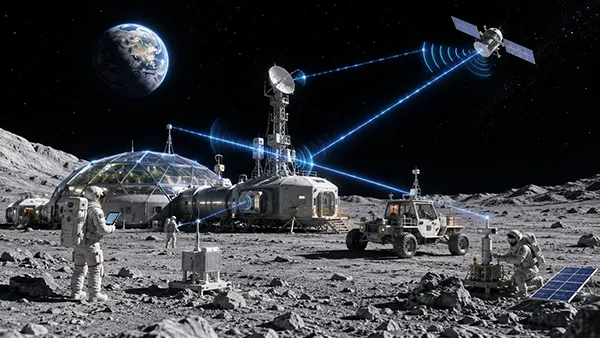
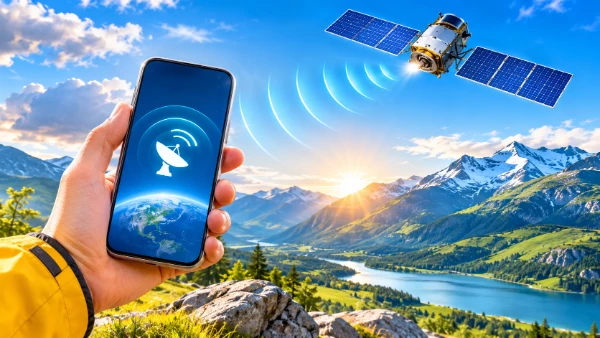
Direct-to-Device technology allows a compatible smartphone to establish a radio connection with a satellite without relying on a nearby mobile mast. Under normal circumstances, a phone exchanges signals with a terrestrial base station, which transfers calls, messages and internet traffic through the operator’s network. With D2D connectivity, a satellite performs part of this role from orbit. The phone transmits a signal towards the spacecraft, which receives the information and passes it into the communications network, often through a ground station. Depending on the technical arrangement, the satellite may also communicate with other spacecraft before the information reaches its destination. This makes it possible to exchange messages and use certain mobile services in areas where traditional coverage is unavailable.
Most current D2D developments use satellites in low Earth orbit (LEO), typically operating at altitudes of several hundred kilometres. These spacecraft are much closer to the Earth’s surface than geostationary satellites, which orbit approximately 35,786 kilometres above the equator. The shorter distance helps reduce communication delays and makes it more practical to receive signals from small smartphone antennas. However, low-orbit satellites move rapidly across the sky, completing an orbit in roughly 90 to 120 minutes, depending on their altitude. A single spacecraft therefore cannot maintain continuous coverage over the same location. Satellite operators address this challenge by deploying constellations containing multiple satellites, enabling communication to continue as different spacecraft move into suitable positions.
One of the most significant developments is the ability to use familiar mobile communication technology for satellite connections. Some satellite networks employ equipment compatible with modified 4G LTE systems, allowing supported smartphones to communicate without major hardware changes. Other services use technologies developed specifically for non-terrestrial networks, known as NTN, which are incorporated into international mobile communication standards. These approaches differ in their technical requirements, but both aim to make satellite access more convenient for ordinary mobile users. Importantly, not every modern smartphone can connect to every satellite network. Compatibility depends on its radio capabilities, operating system, supported frequencies, mobile operator and the particular satellite service available in the country.
How Smartphones Establish a Connection with Satellites
When a compatible smartphone loses its terrestrial mobile signal, it may attempt to establish a satellite connection if the service is available through its operator or built-in software. Some systems search for satellite coverage automatically, while others require the user to open a specific communication function and point the handset towards the sky. Once the phone identifies an available satellite, it exchanges radio signals with the spacecraft. These transmissions carry information such as text messages, emergency requests or location coordinates. The satellite then forwards the data through the appropriate communications infrastructure, allowing it to reach another mobile device, an emergency response centre or an application connected to the wider network.
Establishing this connection involves considerable technical challenges. Smartphones have relatively small antennas and limited transmission power because they are designed primarily to communicate with nearby mobile masts. Satellites must detect these comparatively weak signals from hundreds of kilometres away while travelling at high speed. Engineers compensate by using sensitive receivers, large satellite antennas, carefully controlled radio beams and signal-processing software. Another difficulty is the Doppler effect, which changes the apparent frequency of a radio signal as the satellite moves relative to the smartphone. Modern communication systems account for these changes to maintain a stable connection. Even with these improvements, satellite reception generally remains more sensitive to obstacles and signal conditions than conventional mobile coverage.
For users, the connection process varies between services. Apple’s satellite communication features provide on-screen guidance to help people position their iPhones towards an available satellite. In contrast, T-Mobile’s T-Satellite service, developed with Starlink, is designed to connect eligible smartphones automatically when terrestrial coverage disappears. In either case, an unobstructed view of the sky significantly improves reception. Buildings, thick vegetation, steep mountains and underground locations can prevent or interrupt communication. Messages may also take longer to transmit than through an ordinary mobile network. Under favourable conditions, a satellite message may be delivered relatively quickly, but obstacles or gaps in coverage can extend the process to several minutes. Satellite connectivity therefore offers an additional communication option rather than an assurance of uninterrupted service.
Direct-to-Device Satellite Services and Compatible Smartphones in 2026
By November 2026, several major technology and telecommunications companies are developing or providing Direct-to-Device connectivity. Apple uses satellite communication to support emergency functions, location sharing and messaging on compatible iPhones. SpaceX’s Starlink works with mobile operators to connect supported handsets through satellites equipped with cellular communication technology. AST SpaceMobile is developing satellite networks intended to support broader mobile broadband services directly on ordinary smartphones. These companies use different technical arrangements, and their services are not interchangeable. The available functions, supported devices and geographical coverage depend on the operator involved. Consequently, the presence of D2D technology in a country does not mean every smartphone user can immediately access satellite calls or mobile internet.
Commercial interest in satellite-to-phone connectivity has increased substantially. According to figures published by the Global mobile Suppliers Association in August 2026, 283 partnerships between mobile operators and satellite companies had been announced across more than 100 countries and territories by the end of June. The same research identified 23 partnerships that had launched services by August. These figures demonstrate growing industry investment, although announced agreements do not necessarily indicate that consumer services are already operational. Some partnerships concern technical trials, regulatory arrangements or future commercial deployments. Satellite connectivity is also expanding at different speeds across regions because each country has its own rules governing radio frequencies, telecommunications licences and satellite operations.
Government approval is particularly important because satellites and terrestrial mobile networks may use related radio frequencies. Operators must coordinate their transmissions to avoid harmful interference with existing communications. This requires technical planning, agreements between satellite companies and mobile providers, and permission from relevant national authorities. In June 2026, the GSMA introduced a regulatory guide addressing the development of satellite services, including Direct-to-Device connectivity. The initiative reflected the growing need for consistent rules as more companies begin operating satellite communication networks. For ordinary users, these regulatory requirements explain why satellites can pass over a country without providing a commercially available connection there. Coverage depends not only on spacecraft location but also on licensing, compatible equipment and active service agreements.
Apple, Starlink and AST SpaceMobile: Current Capabilities
Apple became one of the first major smartphone manufacturers to introduce satellite communication into a widely available consumer device with the launch of the iPhone 14 in 2022. By 2026, Emergency SOS via satellite is supported on compatible iPhone 14 and later models in numerous countries, including the United Kingdom, France, Germany, Canada, Australia and the United States. The feature allows users without mobile or Wi-Fi coverage to contact emergency services by answering essential questions and transmitting information about their situation. Depending on the country, supported iPhones can also share their location through Find My, request roadside assistance or exchange personal messages using satellite connectivity. However, the geographical availability of these functions differs. Messages via satellite, for example, is available in selected countries, including the United States, Canada, Mexico and Japan, rather than everywhere Apple’s emergency satellite service operates.
Starlink approaches the technology through partnerships with existing mobile operators. Its Direct to Cell satellites include equipment that communicates with compatible LTE smartphones, reducing the need for consumers to purchase dedicated satellite devices. In the United States, T-Mobile’s T-Satellite service supports text messaging, location sharing and selected applications in qualifying areas beyond terrestrial coverage. Supported functions also include certain picture and audio messages and communication through satellite-optimised applications. T-Mobile has expanded its capabilities to include selected voice communication features through applications such as WhatsApp, although these should not be confused with unrestricted conventional cellular calling. Satellite data remains slower and more limited than ordinary mobile broadband, and some applications cannot operate normally. Device compatibility, coverage and subscription conditions must therefore be checked individually.
AST SpaceMobile is pursuing another approach by developing satellites with large communications arrays intended to provide direct cellular broadband connectivity. The company works with telecommunications operators, including Vodafone and AT&T, to extend mobile services beyond conventional network boundaries. On 27 February 2026, Satellite Connect Europe, established through a partnership between Vodafone and AST SpaceMobile, formally launched its business operations. The company announced plans for five European ground stations and continued cooperation with mobile operators across the region. This represents an important stage in developing European satellite broadband infrastructure, although it does not mean unrestricted commercial connectivity is already available throughout Europe. AST SpaceMobile’s technology aims to support more demanding services, including voice and data communications, as satellite deployment, network integration and regulatory approvals progress.
Advantages, Limitations and the Future of Satellite-to-Phone Technology
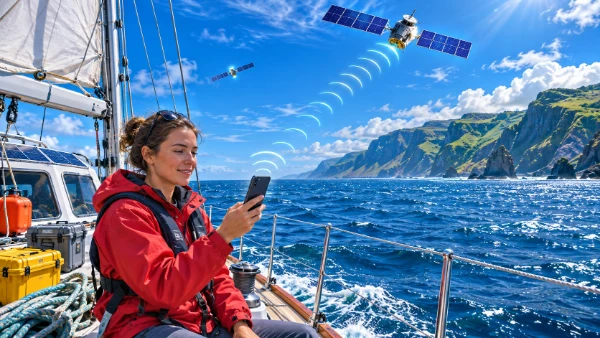
The most immediate advantage of Direct-to-Device connectivity is its ability to extend communication into areas where mobile networks cannot provide dependable coverage. Rural communities, remote roads, mountain routes, coastal regions and isolated workplaces often experience limited access to terrestrial infrastructure. Satellite connections can provide an alternative way to send essential messages or report emergencies. They are particularly valuable during natural disasters, when storms, floods, earthquakes or wildfires may damage mobile masts and disrupt electricity supplies. Emergency responders and affected residents can potentially use satellite-enabled devices to communicate when other connections fail. However, the availability of emergency functions differs between providers, and successful communication still depends on satellite coverage and reception conditions.
Satellite connectivity also creates opportunities for industries operating outside densely populated areas. Agricultural workers may benefit from exchanging information while working across large rural properties, while transport companies could maintain contact with employees travelling along isolated routes. Researchers conducting fieldwork, construction teams in remote locations and travellers exploring national parks may find satellite messaging particularly useful. Some emerging services also support weather information, navigation assistance and location sharing through applications designed for limited data connections. These functions can improve convenience and safety, but their usefulness depends on the network’s capabilities. A service that supports emergency texts cannot automatically provide live video, unrestricted internet browsing or continuous voice calls. Users should distinguish between satellite messaging and more advanced satellite broadband services.
Despite the progress achieved by 2026, Direct-to-Device communication has several important limitations. Satellite signals generally require a reasonably clear view of the sky and can be obstructed by dense forests, buildings, tunnels and surrounding terrain. Network capacity is another challenge because satellite resources must be shared among users across large geographical areas. Connection speeds, response times and supported applications may therefore differ substantially from those available through conventional 4G or 5G networks. Extended attempts to establish a connection can also increase battery consumption, depending on the handset and service. Costs vary between providers, with some satellite functions included in eligible mobile subscriptions and others requiring additional payments. International roaming restrictions and local regulatory conditions may further affect availability when travelling abroad.
Future Development and What Smartphone Users Should Expect
International telecommunications standards are helping bring satellite communication closer to conventional mobile technology. The 3GPP Release 17 specifications introduced important foundations for integrating non-terrestrial networks with mobile communication systems, while subsequent work has addressed additional capabilities and improvements. These standards encourage manufacturers, satellite operators and telecommunications companies to develop equipment capable of working together more effectively. Over time, this could make satellite access easier to incorporate into ordinary smartphones and reduce the need for separate communication systems. Nevertheless, a common technical standard does not guarantee universal compatibility. Device manufacturers must implement the necessary features, operators must support them, and governments must authorise the relevant satellite services before customers can benefit.
The next stage of development is expected to focus on improving network capacity, reducing connection delays and expanding the range of supported applications. More extensive low Earth orbit satellite constellations could provide better geographical coverage and more frequent connection opportunities. Advances in satellite antennas, radio technology and onboard processing may also improve the reliability of communication with small handheld devices. Some companies are already working towards satellite-supported mobile broadband and voice services rather than limiting connectivity to short messages. However, delivering high-speed internet directly to millions of smartphones remains technically challenging. The available satellite spectrum, power requirements and capacity of each spacecraft impose practical limits. Satellite communication is therefore more likely to complement terrestrial 5G networks than replace them in areas where reliable ground infrastructure already exists.
For smartphone users in 2026, the most practical approach is to check the capabilities of their device and mobile operator before relying on satellite connectivity. A compatible handset should have the required software installed, and the selected service must be available in the intended geographical area. Users should confirm whether their subscription includes emergency messaging, ordinary text communication, location sharing, supported applications or voice services, as these functions vary considerably. Travellers heading into remote areas should also understand how to initiate a satellite connection, keep offline maps available and carry sufficient battery power. Direct-to-Device technology is already making mobile communication possible in locations that previously had no conventional signal. Its continuing development could make satellite coverage a familiar part of everyday smartphone use, providing an additional layer of connectivity when terrestrial networks are unavailable.