
Lunar Mobile Communications: How the First Networks for Moon Bases and Research Missions Are Being Built
A permanent human presence on the Moon will require far more than rockets, habitats and power systems. Astronauts, robotic vehicles, scientific instruments and landing craft must also be able to exchange information reliably across a difficult landscape. Engineers are therefore adapting mobile communication technology already used on Earth for operation on the lunar surface. The first cellular equipment reached the Moon in 2025, while NASA, the European Space Agency and commercial companies continue to develop orbital relays, common technical standards and local wireless systems. As of 2026, the result is not yet a complete lunar mobile service. It is an emerging communications structure in which small surface cells, relay satellites and Earth-based control centres will work together. These systems are being designed to support scientific research, vehicle control, astronaut safety, navigation and the routine operation of future Moon bases without requiring every mission to build an entirely separate communications system.
Why the Moon Needs Its Own Mobile Communications Network
Most lunar missions have traditionally communicated directly with large antennas on Earth. This method works when a spacecraft has an unobstructed view of our planet and can reserve time on an appropriate ground station. It becomes less practical when many landers, rovers and crews are operating simultaneously. Earth-based deep-space antennas are expensive resources, and a vehicle hidden behind a hill or crater rim may lose its direct connection even when it remains only a short distance from its base. A local mobile network can handle nearby communications between astronauts, vehicles and equipment, while a separate long-distance link carries selected data back to Earth. This division is similar to the way devices in a remote industrial site can connect to a local private network before information is transferred through a wider communications link. On the Moon, however, every part of that arrangement must operate without conventional maintenance crews, cables or readily available replacement equipment.
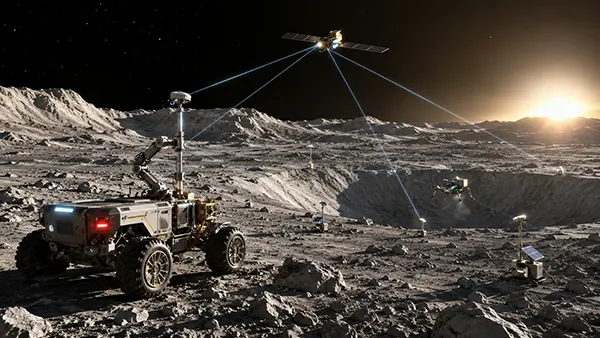
The lunar south polar region makes reliable local communication particularly important. It contains steep slopes, high ridges and deep craters, including permanently shadowed areas that may preserve water ice. These features are scientifically valuable, but they can block radio signals and create sharp differences in lighting and temperature. An astronaut or rover travelling behind a ridge may no longer have a clear radio path to a lander, habitat or Earth. A network of carefully positioned base stations, portable relays or vehicle-mounted communication units could extend coverage around these obstacles. Orbital satellites would provide another route when the Earth is below the local horizon or hidden by the Moon itself. This is essential for far-side missions, which cannot communicate directly with terrestrial ground stations at all. Rather than relying on one powerful transmitter, future missions are expected to combine several links so that information can be redirected when terrain or equipment failure interrupts the normal route.
The expression “lunar mobile network” does not mean that astronauts will use ordinary consumer phones to call Earth through a familiar public service. The first systems are private, mission-controlled networks intended for specialised equipment. A compact cellular base station might connect spacesuits, cameras, rovers, environmental sensors and scientific instruments within a defined operational area. Data would then pass through a lander or orbital relay before travelling approximately 384,000 kilometres between the Moon and Earth. This arrangement cannot remove the unavoidable signal delay caused by that distance, but it can make local communication faster and more flexible. An astronaut could speak to a colleague nearby, receive information from a rover or send live video to a habitat without routing every local exchange through Earth. The same system could prioritise emergency messages, reduce unnecessary long-distance transmissions and allow new devices to join a mission network through agreed communication standards.
What the First Lunar 4G Demonstration Actually Proved
The first cellular network equipment reached the lunar surface during Intuitive Machines’ IM-2 mission in March 2025. Nokia Bell Labs developed the Lunar Surface Communications System with support from NASA’s Tipping Point initiative and integrated it into the Athena lander. Its central unit, described as a network in a box, combined a radio, base station and cellular core in a compact enclosure attached to the lander. Smaller device modules were installed on the Micro Nova hopper and the Lunar Outpost MAPP rover. The planned demonstration was intended to establish 4G/LTE links between Athena and these mobile vehicles. Those connections were expected to carry commands, operational information, telemetry and high-definition video. The lander would then use Intuitive Machines’ long-distance communications service to send relevant information to Earth. This was an important design choice because the local cellular link did not have to perform the separate task of communicating directly across the full Earth–Moon distance.
The mission achieved only part of its original communications objective. After landing, the orientation of Athena’s solar panels severely restricted the electrical power available to its payloads. Nokia’s network received power for approximately 25 minutes. During that period, it started successfully, responded to commands and transmitted operational data through the lander to control teams on Earth. Telemetry indicated that the radio, base station and core network had entered an operational on-air state. The system continued working throughout the available power window, showing that the compact cellular equipment had survived launch, the journey to the Moon, landing and initial operation in the lunar environment. However, the mission did not complete the first cellular call between separate devices on the Moon. By the time the central network was activated, the communication module on the Micro Nova hopper had become too cold to operate, while the mission’s wider power and deployment difficulties prevented the planned surface test.
This result is significant because it provides a measured technical outcome rather than a perfect demonstration created under controlled laboratory conditions. The network itself switched on and operated, but the vehicles and power systems needed to complete the full test were not available at the same time. Future designers can use this experience when deciding how much independent power, heating and thermal protection each communication unit requires. It also shows why a lunar network cannot be treated as an isolated radio product. Its success depends on the lander’s position, the condition of its solar arrays, the thermal state of connected vehicles and the timing of deployment activities. By 2026, the team responsible for Nokia’s space communications work was continuing development under the Modul8 name, including work to adapt cellular equipment for Axiom Space’s next-generation lunar spacesuits. The IM-2 mission therefore served as an initial operational step, not the completion of a ready-made lunar telephone service.
How Engineers Adapt Terrestrial Cellular Technology for the Moon
Using 4G/LTE on the Moon may appear unusual, but it offers a practical advantage: engineers can begin with a well-understood communication standard instead of inventing every element from the beginning. LTE already provides methods for connecting many devices, managing access to radio capacity, transferring video and data, and maintaining links with moving users. Equipment used on the Moon is not copied directly from a terrestrial mobile mast. The functions of several large network components have to be combined into a much smaller unit with strict limits on mass, volume and electricity use. The system must also start with little or no human assistance after landing. Software needs to recognise attached devices, manage connections and report its condition to mission controllers. Reusing an established standard can make it easier for spacesuits, vehicles and scientific instruments from different suppliers to communicate, provided that their equipment follows the same agreed specifications.
The physical environment creates more difficult problems than the basic communication method. Lunar equipment must survive vibration and acceleration during launch, mechanical shock during landing, radiation, abrasive dust and operation in a vacuum. Without an atmosphere, heat does not move away from electronics in the same way it does on Earth. Hardware exposed to sunlight may become extremely hot, while equipment in shadow can cool rapidly below its operating range. The long lunar day and night, each lasting roughly two Earth weeks, add another challenge for systems intended to remain on the surface. Engineers must therefore combine insulation, heaters, radiators and carefully managed operating periods. Connections and antennas also need protection from dust that can cling to surfaces and enter mechanical parts. Because sending a repair team is not realistic, equipment must monitor its own condition and recover from temporary faults wherever possible. A successful network is consequently judged not only by its data speed but by how reliably it functions within limited power and temperature conditions.
Coverage must be planned around lunar geography rather than conventional urban streets. Radio signals generally travel well in the Moon’s near-vacuum, but they can still be blocked by solid terrain. A single base station placed on low ground may have a limited useful area if craters or ridges surround it. Engineers can improve coverage by mounting antennas on a lander, elevated mast, rover or high point with a clear view of the working zone. Larger bases may use several small cells connected to one another, while mobile relay units could accompany crews travelling beyond the main habitat. Power remains a central consideration because stronger transmitters, additional relay stations and continuous heating all consume energy needed by other systems. Network planning will therefore involve choosing which areas require permanent coverage and which can be served temporarily during a particular scientific or construction task. The objective is not to cover the entire Moon at once, but to provide dependable communication where people and equipment are actually working.
How Astronauts, Rovers and Scientific Instruments Will Use the Network
For astronauts, the most visible use will be voice and video communication. A network-connected spacesuit could transmit speech, suit status, camera images and medical telemetry to nearby crew members or a lunar habitat. High-definition video could help specialists on Earth understand what an astronaut is seeing, although the distance-related delay means that terrestrial controllers cannot react instantly. The local lunar connection would remain useful even when the Earth link is temporarily unavailable. Crew members could continue speaking to one another, consulting maps and receiving warnings from nearby equipment. A base might also store outgoing information until an orbital relay becomes available. Emergency traffic could receive priority over routine scientific files, while location and movement data could help mission controllers recognise when an astronaut has stopped unexpectedly or moved outside the planned working area. These capabilities make communication part of the safety system rather than merely a convenient way to send reports.
Robotic vehicles are likely to generate far more data than early lunar missions. Cameras, drills, spectrometers, ground-penetrating radar and environmental sensors can produce continuous information while a rover travels. A local cellular link allows the vehicle to send selected results to a lander or habitat without carrying a separate long-distance Earth transmitter. It may also receive new routes, software instructions and operating limits from the mission team. Some routine driving can be handled autonomously because commands from Earth cannot overcome the signal delay, but human operators may still intervene when a rover encounters unusual terrain. Nearby astronauts could control or supervise a machine through the local network with much less delay. Scientific instruments placed around a landing area could use lower data rates to report temperature, radiation, dust movement or structural conditions. Combining many such devices within one managed network would reduce the need to design a unique radio system for every sensor.
Future bases will probably use several wireless methods rather than depending entirely on cellular technology. Wi-Fi may be suitable inside habitats or within small work areas, while specialised direct radio links will remain important for emergencies and particular spacecraft operations. Cellular systems offer managed coverage and mobility over larger surface zones, but no responsible mission design would allow one base station to become the only route for critical communication. Astronauts may carry a direct backup radio, and vehicles may retain the ability to store data when a connection is lost. Orbital relays can provide alternative paths to Earth, while surface units may automatically move traffic to another cell if the nearest one fails. Communication systems will also need to work with navigation and timing services so that vehicles can identify their position and share a consistent time reference. The practical lunar network will therefore be a combination of complementary technologies, each selected for a particular distance, environment and level of importance.
From One Surface Cell to a Wider Lunar Communications Infrastructure
A small 4G/LTE cell can connect equipment near a lander, but sustained lunar activity requires a much broader arrangement. NASA’s LunaNet concept provides a common framework for communications, navigation, timing and related information services around the Moon. Its purpose is not to create one network owned and operated entirely by NASA. Instead, agreed interfaces and technical rules should allow government agencies and commercial service providers to build systems that can work together. NASA, ESA and the Japan Aerospace Exploration Agency have contributed to these interoperability standards. A rover built for one mission could eventually use a compatible relay supplied by another organisation instead of carrying a dedicated system for every possible situation. NASA’s Lunar Communications Relay and Navigation Systems project is also preparing commercial orbital services for astronauts, landers and spacecraft. These relays are intended to reach polar and far-side locations where direct communication with Earth is limited or impossible.
Europe is developing a related orbital system through ESA’s Moonlight programme. The planned full arrangement consists of four navigation satellites and one high-capacity communications satellite linked to ground stations on Earth. Coverage is being designed with particular attention to the lunar south pole, where many planned scientific and human missions are concentrated. Moonlight is expected to support data transfer, surface mobility, navigation and more precise landings. Lunar Pathfinder, built by Surrey Satellite Technology Ltd, is intended to act as an early commercial relay before the larger constellation is complete. As of 2026, SSTL lists Lunar Pathfinder for launch in 2027, reflecting a delay from earlier ESA schedules that anticipated initial activity sooner. The spacecraft is designed to communicate with surface and orbital users through UHF and S-band links and to send information towards Earth through an X-band connection. Broader Moonlight services are still planned for phased introduction later in the decade.
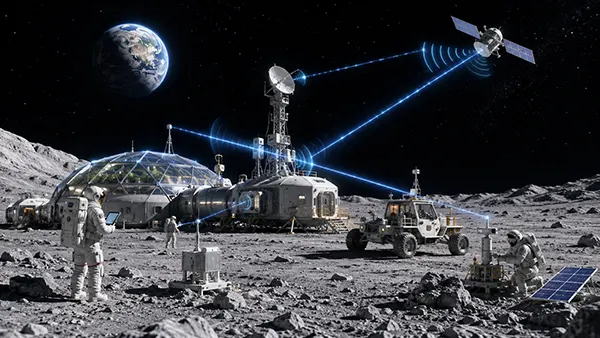
These orbital systems and local mobile cells perform different but connected jobs. A spacesuit may use LTE to reach a nearby base station. That base station can pass selected traffic to a lander, which may communicate with a lunar relay satellite. The satellite then forwards the data to an Earth ground station and the appropriate mission centre. Information travelling in the opposite direction follows a similar chain. When no complete path is available, equipment may store the data and forward it later, a method useful when a relay moves out of view or power must be conserved. Navigation signals from orbit could also help surface vehicles calculate their position without relying entirely on Earth-based tracking. Over time, several providers may offer overlapping services, giving missions a choice of coverage and reducing dependence on a single spacecraft. The long-term aim resembles essential infrastructure more than an individual mission experiment: users connect to an available service instead of building every communication link themselves.
What Must Happen Before Lunar Mobile Service Becomes Routine
The next requirement is repeated testing under realistic conditions. The IM-2 result showed that the central cellular system could reach the Moon and operate, but it did not demonstrate a complete connection between moving surface users. Future missions will need to measure coverage over different terrain, test handovers between cells and examine how antennas behave near habitats, vehicles and large machinery. Engineers must also determine how long network equipment can survive repeated periods of darkness and extreme cold. Power systems, batteries and heaters may prove just as important as the radios. Hardware will need modular designs so that robotic equipment or astronauts can replace a failed unit without rebuilding the entire communications system. Mission planners must decide which components require permanent operation and which can shut down when no crew is present. These tests will gradually establish realistic expectations for range, capacity and service life rather than relying solely on computer models or terrestrial trials.
Cooperation and regulation will also shape the network. Radio frequencies must be coordinated so that nearby missions do not interfere with one another or disturb sensitive scientific observations. The Moon’s far side is especially valuable for radio astronomy because it is shielded from much of Earth’s radio noise, making careless transmission potentially harmful to research. Communication protocols must include secure identification, access control and protection against corrupted or unauthorised commands. A scientific sensor may present little direct risk, but an insecure link to a rover, power unit or life-support system could have serious consequences. Agencies and suppliers must also agree on navigation references and lunar timekeeping so that separate systems interpret positions and event times consistently. LunaNet and related international work are intended to address these shared requirements, although technical standards will continue to develop as more equipment is tested and more organisations begin operating near the Moon.
In 2026, lunar mobile communication remains at an early but measurable stage. A cellular network has operated on the surface, NASA is testing how established wireless standards can support crews and vehicles, commercial lunar relay services are under development, and ESA is building the first elements of Moonlight. None of this yet provides continuous mobile coverage across a base, the south polar region or the Moon as a whole. The first practical deployments are likely to be private local networks serving one landing zone, habitat or group of vehicles. Coverage can then expand through additional cells, elevated antennas and orbital relays as activity increases. The most important measure of progress will not be whether astronauts can use familiar-looking mobile devices. It will be whether communication remains available during routine work, scientific operations and emergencies despite difficult terrain, limited electricity and equipment faults. Reliable lunar networks will become useful when crews can treat them as dependable infrastructure rather than temporary experiments.