
Deepfake Protection Technologies: How Video, Voice and Documents Will Be Verified in 2026
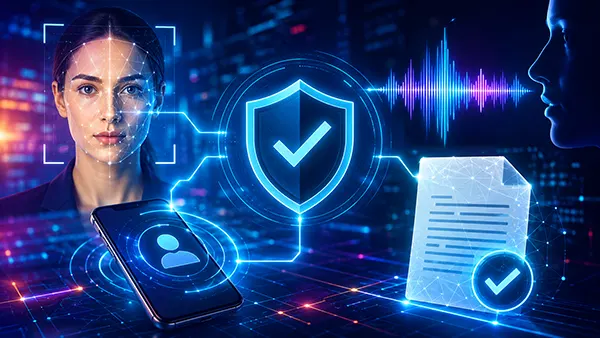
Deepfake technology has evolved from a niche research project into a widespread challenge affecting businesses, governments, media organisations and ordinary citizens. Artificial intelligence can now generate highly convincing videos, clone voices within minutes and create forged digital documents that are difficult to identify with the naked eye. As a result, new verification technologies are becoming an essential part of cybersecurity, fraud prevention and digital identity management. In 2026, organisations increasingly rely on a combination of AI detection systems, cryptographic authentication and digital provenance standards to determine whether content is genuine or manipulated.
Why Deepfakes Have Become a Major Security Concern
The quality of AI-generated content has improved dramatically over the past few years. Modern generative models can reproduce facial expressions, natural speech patterns and realistic document layouts with a level of accuracy that was previously impossible. This creates significant risks for financial institutions, employers, public authorities and online services that depend on digital interactions.
Cybercriminals are actively using voice cloning to impersonate executives, customer support agents and family members. Several documented fraud cases have involved attackers using AI-generated voices to convince employees to transfer money or disclose sensitive information. As voice synthesis becomes more accessible, organisations can no longer rely solely on traditional verification methods.
Video deepfakes present an equally serious challenge. Manipulated footage can be used to spread misinformation, damage reputations or influence public opinion. Because videos are often perceived as strong evidence, the ability to create convincing fake recordings has forced technology companies and governments to invest heavily in authentication and detection systems.
Industries Most Affected by Deepfake Threats
The financial sector remains one of the primary targets. Banks, payment providers and insurance companies process large volumes of identity verification requests every day. Deepfake videos and synthetic voices can be used to bypass remote onboarding procedures if adequate safeguards are not in place.
Media organisations face increasing pressure to verify the authenticity of visual content before publication. Newsrooms now employ forensic analysis tools capable of identifying inconsistencies in lighting, facial movements, metadata and compression patterns that may indicate manipulation.
Government agencies and law enforcement bodies are also strengthening verification procedures. Digital evidence submitted during investigations is often examined using specialised forensic software designed to identify traces of AI-generated content and establish a reliable chain of authenticity.
How Video and Voice Verification Technologies Work
One of the most important developments in 2026 is the adoption of content provenance systems. These systems create secure records showing where a piece of media originated, when it was created and whether any modifications occurred after capture. The Coalition for Content Provenance and Authenticity (C2PA) standard is becoming increasingly influential in this area.
AI-based detection models continue to play a crucial role. These systems analyse thousands of characteristics that are difficult for humans to notice, including abnormal blinking patterns, unnatural skin textures, inconsistencies in shadows, audio artefacts and discrepancies between speech and lip movements. Detection algorithms are regularly updated to keep pace with evolving generative technologies.
Biometric verification adds another layer of protection. Instead of relying solely on facial recognition, modern systems evaluate multiple behavioural indicators, including eye movement, head positioning, facial micro-expressions and real-time user interactions. This makes it more difficult for attackers to use pre-recorded or AI-generated content successfully.
Advanced Voice Authentication Methods
Voice cloning has become sophisticated enough to mimic accents, emotions and speech rhythms. To counter this threat, organisations increasingly use liveness detection techniques that analyse whether speech is being generated by a real person in real time rather than by an AI model.
Many authentication systems now combine voice analysis with contextual verification. For example, users may be asked to repeat random phrases, answer dynamic questions or perform specific actions during a call. These challenges are significantly harder for synthetic voice systems to handle convincingly.
Machine learning tools also examine acoustic fingerprints that are often left behind by voice generation models. Subtle irregularities in frequency patterns, background noise behaviour and signal transitions can reveal signs of artificial speech even when the imitation sounds highly realistic to human listeners.
The Future of Document Verification and Digital Identity
Document fraud is evolving alongside generative AI. Modern image-generation systems can create highly convincing passports, licences, utility bills and certificates. As a result, organisations increasingly require digital verification mechanisms rather than relying exclusively on visual inspection.
Cryptographic signatures are becoming a central component of document security. When a document is issued digitally, trusted authorities can attach cryptographic credentials that allow recipients to verify authenticity instantly. Any modification to the original file invalidates the signature and exposes tampering attempts.
Digital identity wallets are also gaining momentum. These systems allow individuals to store verified credentials issued by governments, educational institutions and businesses. Instead of uploading copies of sensitive documents, users can share cryptographically verified proofs that confirm specific information while reducing privacy risks.
What Verification May Look Like Beyond 2026
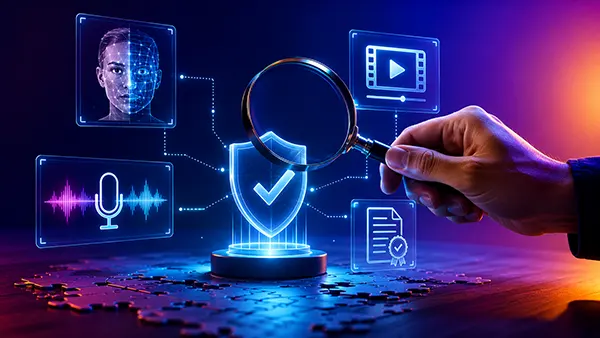
Future verification systems are expected to combine AI detection, cryptographic authentication and decentralised identity technologies into unified trust frameworks. Rather than depending on a single security mechanism, organisations will evaluate multiple evidence sources before accepting digital content as genuine.
Hardware-based authentication may become more widespread as cameras, microphones and mobile devices incorporate secure capture technologies. These systems can generate tamper-resistant records at the moment content is created, making subsequent manipulation easier to detect.
The battle between deepfake creators and verification technologies will continue to evolve. However, the growing adoption of provenance standards, biometric validation, cryptographic credentials and advanced forensic analysis suggests that organisations in 2026 are significantly better equipped to identify manipulated videos, cloned voices and forged documents than they were only a few years ago.